
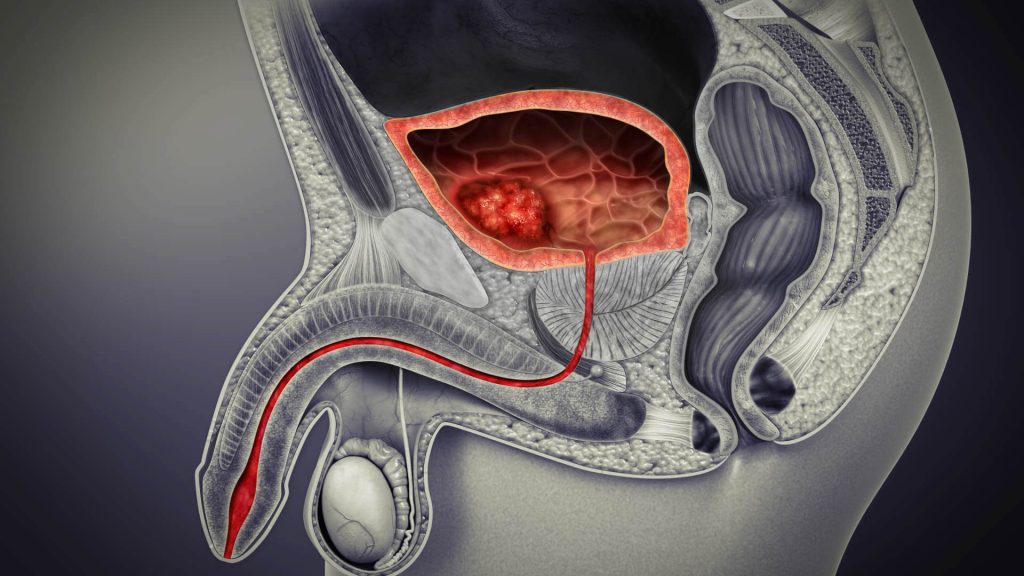
Bladder cancer is one of the most common cancers affecting the urinary system. It typically begins in the urothelial cells lining the inside of the bladder—a hollow organ in the lower abdomen that stores urine. Early detection significantly improves outcomes, making awareness and screening critical.
| Therapy | Type | Indications | Key Side Effects | Key Considerations |
|---|---|---|---|---|
| BCG | Immunotherapy | High-risk NMIBC (CIS, high-grade Ta/T1) | Dysuria, frequency, hematuria, fever, fatigue, rare sepsis | Gold standard; requires induction + maintenance; shortages common |
| Mitomycin C (MMC) | Chemotherapy | Intermediate- to high-risk; post-TURBT | Chemical cystitis, rash, bladder irritation | Often used post-TURBT (within 24 hrs); some use for maintenance |
| Gemcitabine | Chemotherapy | BCG-unresponsive or intermediate-risk NMIBC | Mild bladder symptoms (dysuria, frequency) | Good safety profile; increasing use in BCG failure or shortage |
| Gemcitabine + Docetaxel | Chemotherapy (Combo) | BCG-unresponsive or relapsing disease | Mild urinary symptoms, rare systemic effects | Effective salvage regimen; growing role in BCG-unresponsive cases |
| Adstiladrin (nadofaragene firadenovec) | Gene Therapy | BCG-unresponsive CIS ± Ta/T1 | Fatigue, urgency, dysuria, hematuria | FDA-approved gene therapy; instilled every 3 months; IFNα gene-based |
| Anktiva (N-803) | Immunotherapy | BCG-unresponsive CIS ± papillary tumors (with BCG) | Fatigue, flu-like symptoms, urinary urgency | FDA-approved with BCG; IL-15 superagonist; promising results in BCG-unresponsive disease |
| UGN-102 (mitomycin gel) | Chemotherapy | Low-grade intermediate-risk NMIBC | Urinary frequency, dysuria, hematuria, bladder spasms | Thermo-sensitive gel; prolongs drug contact time; promising in low-grade tumors |
| TAR-200 (gemcitabine implant) | Chemotherapy delivery system | BCG-unresponsive NMIBC | Urinary tract irritation, dysuria, urinary retention | Implant releasing gemcitabine over weeks; alternative delivery approach |
Regular cystoscopy, urine tests, and imaging to monitor for recurrence.
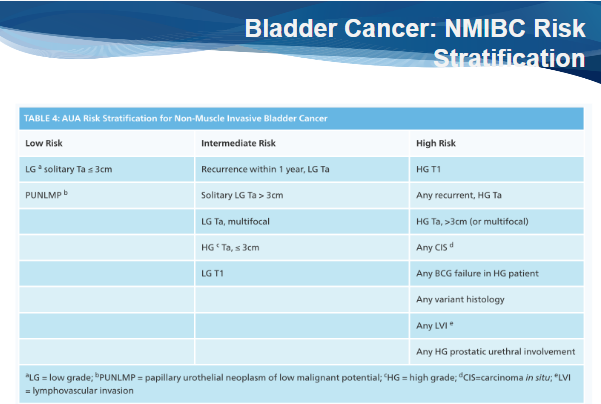
| Risk Category | Cystoscopy | Urine Cytology | Imaging (Upper Tract) | Other Notes |
|---|---|---|---|---|
| Low-Risk | Every 3 months for 6–12 months, then annually | Optional | Only if indicated (e.g., hematuria) | May stop after 5 years if no recurrence |
| Intermediate-Risk | Every 3 months for 2 years, every 6 months to 5 years, then annually | At each visit | Every 1–2 years or as needed | Consider single-dose intravesical chemo post-TURBT |
| High-Risk | Every 3 months for 2 years, every 6 months until year 5, then annually | At each visit | Annually (CT urogram or ultrasound + cytology) | Consider repeat TURBT, BCG maintenance, or early cystectomy |
| Risk Group | 1-Year Recurrence Risk | 5-Year Recurrence Risk | 1-Year Progression Risk | 5-Year Progression Risk | Common Characteristics |
|---|---|---|---|---|---|
| Low Risk | 15% | 31% | <1% | ~1% | Small, single, low-grade Ta tumor, no CIS |
| Intermediate Risk | 24–38% | 38–62% | 1–5% | 6–17% | Multiple or recurrent low-grade tumors, no CIS |
| High Risk | ~61% | ~78% | ~17% | >45% | High-grade T1, CIS, large/multiple tumors |
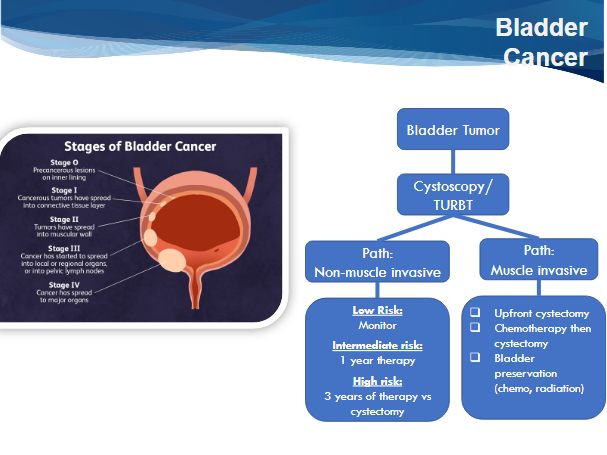
Muscle-Invasive Bladder Cancer (MIBC) is a type of bladder cancer where the tumor grows into the muscle layer of the bladder wall (the detrusor muscle). This is a more aggressive form of bladder cancer compared to non-muscle invasive types and typically requires more intensive treatment.
The prognosis depends on the stage and grade of the tumor at diagnosis and response to treatment. Early diagnosis and multimodal treatment improve survival rates.
Non-Muscle Invasive Bladder Cancer (NMIBC) refers to bladder cancers that are confined to the inner layers of the bladder wall and have not spread to the muscle layer. These cancers account for approximately 75% of newly diagnosed bladder cancer cases.
Muscle-Invasive Bladder Cancer (MIBC) is a type of bladder cancer where the tumor grows into the muscle layer of the bladder wall (the detrusor muscle). This is a more aggressive form of bladder cancer compared to non-muscle invasive types and typically requires more intensive treatment.
Incidence: Bladder cancer is the 6th most common cancer in the United States.
Gender: Men are four times more likely to develop bladder cancer than women.
Age: Most cases occur in individuals over the age of 55, with the average age at diagnosis around 73.
Within the United States, there are approximately 82,000 new cases of bladder cancer diagnosed yearly.
Smoking: The leading cause, accounting for more than 50% of cases.
Chemical Exposure: Long-term exposure to industrial chemicals (e.g., in dye, rubber, or leather industries).
Chronic Bladder Irritation: Infections, stones, and long-term catheter use may increase risk.
Family History: Genetics may play a role in a small percentage of cases.
Radiation & Chemotherapy: Past pelvic radiation or use of certain drugs like cyclophosphamide.
Blood in the urine (hematuria) – often painless and intermittent.
Frequent urination or urgency.
Pain or burning sensation during urination.
Pelvic or lower back pain (in more advanced cases).
Note: These symptoms can also be caused by benign conditions like infections or stones. Evaluation by a urologist is essential.
Cystoscopy: Direct visualization of the bladder using a thin camera.
Imaging: CT urogram or ultrasound for detailed internal views.
Biopsy: Tissue sample collection during cystoscopy to confirm diagnosis.
Treatment is personalized based on the type, stage, and grade of the tumor:
Non-Muscle-Invasive (NMIBC):
Transurethral Resection of Bladder Tumor (TURBT)
Intravesical therapy (e.g., BCG, Mitomycin C, Gemcitabine/Docetaxel, Adstiladrin, Anktiva, etc)
Muscle-Invasive (MIBC):
Radical cystectomy (bladder removal) with or without systemic chemotherapy
Bladder-sparing trimodal therapy: Maximal TURBT, Chemotherapy, Radiation
Advanced/Metastatic:
Immunotherapy (e.g., immune checkpoint inhibitors)
Targeted therapies
Bladder cancer has a high recurrence rate, especially in non-invasive forms. Regular follow-up with cystoscopies and urine tests is crucial to monitor for recurrence or progression.When to See a Urologist
If you experience blood in urine, persistent urinary discomfort, or unexplained changes in bladder habits, consult a urologist promptly. Early diagnosis leads to better outcomes and more treatment options.
Whether you’re seeking expert care for a urological condition or looking for a second opinion, we’re here to support you every step of the way. Reach out to schedule an appointment, ask questions, or learn more about personalized, minimally invasive treatment options tailored to your needs.